As the coronavirus outbreak affects more states, demand for doctors, nurses, and other critical healthcare workers is soaring across the country. As 16.4 percent of all workers in the U.S. healthcare industry, 2.8 million immigrant healthcare professionals are playing a vital role on the front lines against the disease. In some states, immigrants make up an even more significant share of the healthcare workforce. In New York State, the epicenter of the U.S. coronavirus outbreak, more than 400,000 immigrants made up at least one in three healthcare workers in 2018.
Figure 1: Immigrant Healthcare Workers in the United States Source: NAE Analysis of 1-year sample from the 2018 American Community Survey
State
Number of Foreign-born Healthcare Workers
Share of All Healthcare Workers, Foreign-born
United States
2,804,897
16.4%
New York
402,731
34.3%
New Jersey
154,508
30.6%
California
556,016
31.6%
Michigan
45,102
8.1%
Louisiana
7,389
3.0%
Massachusetts
108,984
22.6%
Florida
307,153
28.4%
Illinois
114,405
16.9%
Washington
62,684
16.9%
Pennsylvania
75,038
9.3%
Texas
249,280
18.6%
Virginia
57,234
14.5%
Georgia
50,121
10.7%
Arizona
47,087
14.3%
Maryland
85,522
24.9%
North Carolina
38,019
7.3%
Ohio
41,777
5.8%
Even before the Covid-19 crisis began, America faced a severe shortage of healthcare workers. In 2018, there were 27 open healthcare practitioner jobs—such as doctors, surgeons, registered nurses—for every available unemployed healthcare practitioner. Overall in the healthcare sector, there were 12.3 open job openings for every available unemployed worker.
In states hit the hardest by Covid-19, where the number of severe cases requiring intensive medical care has surged, acute shortages of healthcare professionals could significantly limit capacities to diagnose, treat, and assist patients quickly. There were 20.9 open jobs for every unemployed healthcare practitioner in New York, 26.8 in California, and 36.7 in Washington in 2018.
Figure 2: Shortage of Healthcare Workers in the United States Source: Burning Glass Labor Insights and NAE Analysis of 5-year sample from the 2018 American Community Survey
State
Ratio of open healthcare practitioner jobs to unemployed healthcare practitioners, 2018
Ratio of open healthcare jobs to unemployed healthcare workers, 2018
United States
27.0
12.3
New York
20.9
7.1
New Jersey
22.3
11.0
California
26.8
12.7
Michigan
23.5
10.2
Massachusetts
31.6
14.6
Florida
19.0
10.4
Illinois
20.7
8.1
Louisiana
23.1
7.6
Washington
36.7
21.0
Pennsylvania
19.8
9.7
Texas
20.8
9.0
Virginia
33.0
13.8
Georgia
37.4
15.8
Arizona
35.2
16.9
Maryland
23.4
13.4
North Carolina
21.6
11.0
Ohio
32.5
11.0
Data shows that to some extent, immigrants are helping to fill these critical personnel gaps. In 2018, more than 244,000 immigrants served as physicians and surgeons in the country, making up 28.2 percent of the workforce in these occupations. Meanwhile, immigrants made up one-fourth of all health aides, including home health aides, personal care aides, and nursing assistants, and 15.3 percent of all nurses. In other healthcare occupations that are particularly important in the Covid-19 crisis, immigrants also made up significant shares of the workforce, including about one in five lab technicians, more than one in eight respiratory therapists, and one in 20 emergency medical technicians.
Figure 3: Select Occupations in the Healthcare Industry in the United States Source: NAE Analysis of 1-year sample from the 2018 American Community Survey
Occupation
Number of Immigrant Workers
Immigrants’ Share of Workforce
Physicians and Surgeons
244,249
28.2%
Health Aides
578,270
25.3%
Lab Technicians
58,013
19.6%
Nurses
597,426
15.3%
Respiratory Therapists
14,593
13.6%
Emergency Medical Technicians
8,543
5.1%
Again, in the states that are struggling with some of the sharpest increases in new infections, immigrant healthcare workers prove to be even more vital. In New Jersey, which has the second-largest number of confirmed cases in the country, immigrants made up two in five physicians and surgeons, three in ten nurses, and one in two health aides in 2018.
Figure 4: Immigrants’ Share of Healthcare Workforce in Select State Source: NAE Analysis of 1-year sample from the 2018 American Community Survey
State
Physicians and Surgeons
Nurses
Health Aides
New York
36.4%
30.9%
60.7%
New Jersey
40.3%
29.5%
53.7%
California
33.1%
35.2%
44.3%
Michigan
27.1%
7.0%
4.8%
Massachusetts
34.5%
17.1%
39.8%
Florida
36.5%
25.8%
45.6%
Illinois
30.6%
17.5%
20.9%
Washington
24.1%
15.9%
29.0%
Pennsylvania
23.7%
7.9%
11.7%
Texas
31.7%
20.6%
24.5%
Virginia
32.4%
12.7%
17.3%
Georgia
27.8%
11.1%
17.5%
Arizona
28.8%
13.0%
21.4%
Maryland
31.0%
26.6%
40.9%
North Carolina
16.7%
6.8%
4.4%
Ohio
27.1%
3.7%
7.8%
Many immigrant healthcare workers also speak multiple languages, making them a valuable asset to reach vulnerable communities who may have limited English language proficiency. In a medical emergency like Covid-19, it is critical that healthcare professionals can communicate clearly with each and every patient, regardless of language.
The vast majority of immigrant healthcare workers, about 69 percent in the country, spoke both English and at least another language in 2018. Bilingual skills are even more common among immigrant physicians and surgeons, nurses, and lab technicians, with more than 70 percent of them speaking more than one language.
Figure 5: Bilingual Immigrants Healthcare Workers in the United States Source: NAE Analysis of 1-year sample from the 2018 American Community Survey
Share of Immigrant Workforce, Bilingual
All Healthcare Workers
68.9%
Physicians and Surgeons
74.9%
Nurses
72.3%
Health Aides
56.2%
Lab Technicians
78.9%
Respiratory Therapists
68.5%
The shares of immigrant healthcare workers with bilingual skills are higher than the national average in some states like California, Michigan, Illinois, and Washington, where more than 70 percent of all immigrant healthcare workers spoke another language in addition to English in 2018.
Figure 6: Bilingual Immigrant Healthcare Workers in Select States Source: NAE Analysis of 1-year sample from the 2018 American Community Survey
State
Share of Immigrant Healthcare Workers, Bilingual
New York
53.1%
New Jersey
66.5%
California
77.5%
Michigan
74.8%
Massachusetts
69.7%
Florida
67.1%
Illinois
78.0%
Washington
75.0%
Pennsylvania
67.8%
Texas
71.1%
Virginia
74.0%
Georgia
60.1%
Arizona
71.1%
Maryland
71.0%
North Carolina
63.2%
Ohio
68.1%
In this unprecedented war against a global pandemic, immigrant healthcare workers are fighting side by side with their U.S.-born counterparts to save lives and keep our communities safe. Among them, Dr. Tarig Elhakim, a doctor from Sudan, is working on the front line in a Miami hospital. He says the country needs more healthcare professionals like himself to contain the virus.
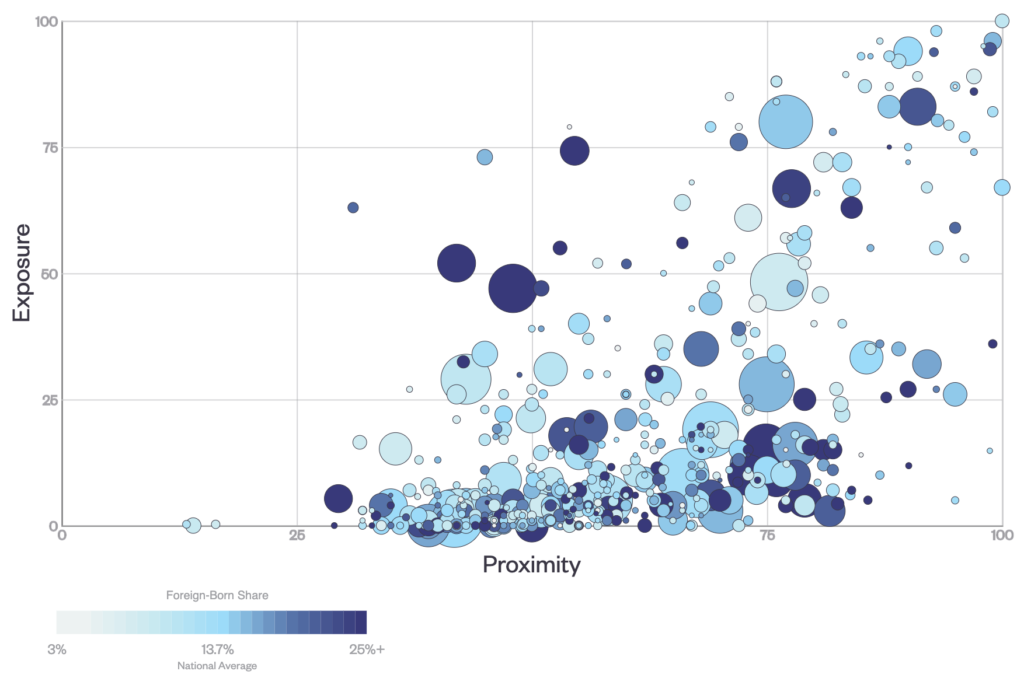
If you want to explore how immigrants often disproportionately serve in some of the most at-risk jobs in the Covid-19 crisis, including the healthcare occupations featured in this brief, click the image below to explore our data visualization.
Finally, check out our research portal of Immigration and Covid-19. If you have any specific questions about our data, please reach out to us at [email protected].